
TG VoIP 4G Gateway Integration Guide
A TG-series VoIP 4G gateway holds one or more carrier SIM (Subscriber Identity Module) cards and presents each mobile channel to your Cloud Voice hosted PBX as a standard SIP trunk. That lets the phone system place and receive calls over the cellular network, handy for reaching mobile numbers at on-net rates, keeping a fallback path when your SIP carrier is unavailable, or handling calls per carrier. This guide walks through a complete example that connects a TG400 gateway to Cloud Voice and puts its 4G trunks to work.
How the integration works
Section titled “How the integration works”The gateway registers to Cloud Voice, and each SIM card it carries becomes a 4G trunk on the PBX. Once a trunk is up, it behaves like any other trunk: outbound routes decide which calls leave over it, and inbound routes decide where its incoming calls land. The gateway simply converts between the mobile network and SIP in both directions.
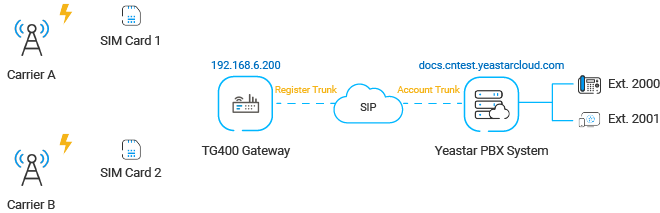
Reference environment
Section titled “Reference environment”Every procedure in this guide refers back to the setup below. Your firmware versions and addresses will differ, but the workflow is the same, substitute your own values wherever they appear.
| Equipment | Firmware version | IP address / domain |
|---|---|---|
| Cloud Voice | 84.10.0.30 | pbx.example.com |
| TG400 4G Gateway | 91.3.0.21 | 192.168.6.200 |
The TG400 in this example has two SIM cards installed, one from each of two carriers. The mobile-number prefix of each carrier matters later, because it drives the outbound and inbound routing decisions.
| SIM card | Carrier | Mobile prefix |
|---|---|---|
| SIM card 1 | Carrier A | 92 |
| SIM card 2 | Carrier B | 10 |
In this guide
Section titled “In this guide”Work through the topics in order. The first brings the gateway and the PBX together; the remaining two use the SIM prefixes above to route calls in each direction.
- Connect Cloud Voice and the TG400 Gateway, register the gateway with the PBX and bring up its 4G trunks.
- Make outbound calls through a designated 4G trunk, send calls out over the trunk that matches the dialed number’s carrier so same-network calls stay cheap.
- Route calls from different carriers to different destinations, deliver incoming calls to different places depending on which carrier’s 4G trunk they arrive on.
Question about this page?
Ask the AI assistant. It starts from this page, then searches the rest of the docs.
Ask Cloud Voice AI
Answers are AI-generated from the docs and may contain mistakes. Verify with the linked pages.