
Set up Contact Synchronization from LDAP Server
Synchronizing contacts from your LDAP (Lightweight Directory Access Protocol) directory copies those records into Cloud Voice as company contacts. Once they are in the system, extension users can dial them straight from the Cloud Voice App, and you can route inbound calls from those contacts to specific destinations based on which phonebook each one lands in.
Capacity limits
Section titled “Capacity limits”The number of company contacts and phonebooks your system can hold scales with how many extensions it has. Use the table below to confirm you stay within the ceiling for your deployment.
| Number of extensions (N) | Max. company contacts (total) | Max. company phonebooks |
|---|---|---|
| N ≤ 50 | 50,000 | 100 |
| 50 < N ≤ 200 | 200,000 | 200 |
| N > 200 | 500,000 | 500 |
Before you begin
Section titled “Before you begin”Make sure you have already mapped the contact fields you want between Cloud Voice and your LDAP server. Synchronization relies on that mapping to know which LDAP attributes to import.
Set up contact synchronization
Section titled “Set up contact synchronization”-
On the LDAP configuration page, scroll down to the Contacts Synchronization section.
-
Turn on Contacts Synchronization, then configure the settings.
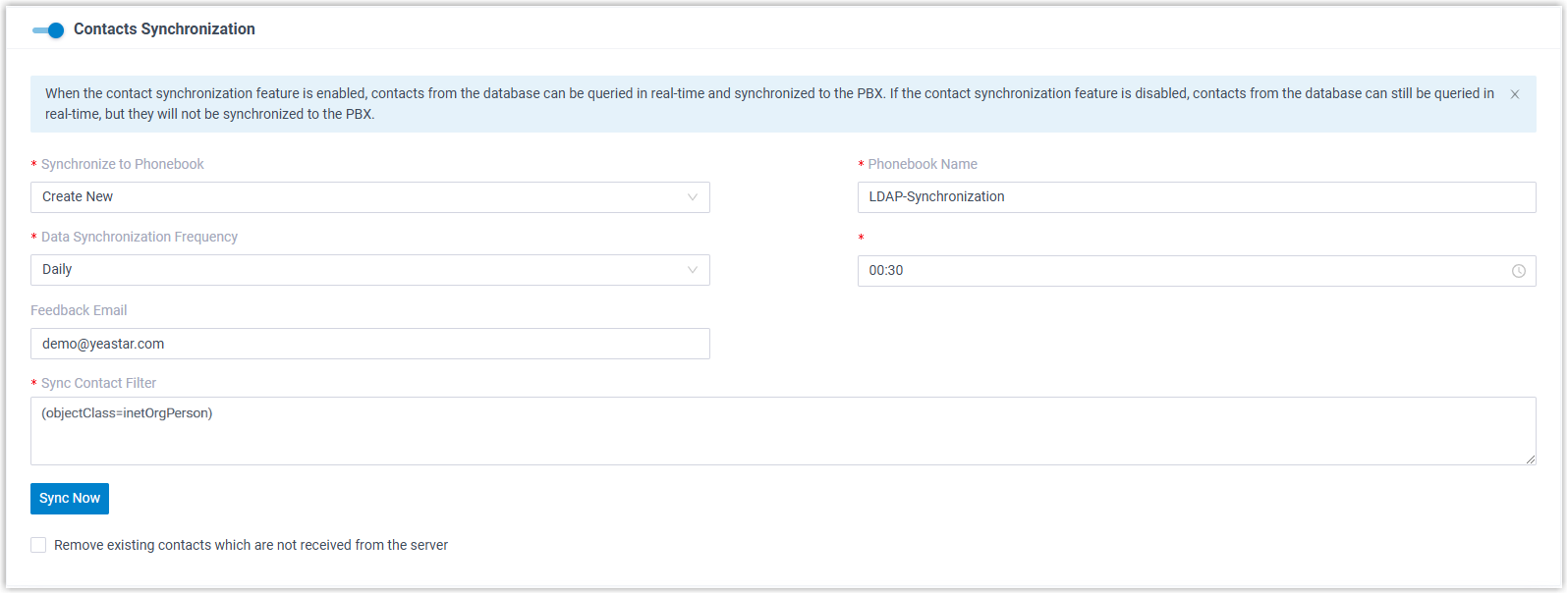
Synchronize to Phonebook: Choose where the imported contacts are stored:
-
Create New: Build a new phonebook from scratch. Enter a name for it in the Phonebook Name field.
-
Read Specific Property Value and Create New: Generate phonebooks automatically from an LDAP attribute. Enter the attribute name in the Property Name field.
-
An existing phonebook: Store the contacts in an empty phonebook you already have. These come from the phonebooks you created under Contacts > Phonebooks.
The remaining settings control how and when the sync runs:
Setting Description Data Synchronization Frequency How often contacts are synchronized. Pick a frequency, then set the time in the field that appears. Feedback Email Optional. An email address to notify with the result of each sync. Enter up to 5 addresses, separated by semicolons ( ;).Sync Contact Filter The filter statement that decides which LDAP entries are imported. For example, (objectClass=inetOrgPerson)imports every LDAP contact.Remove existing contacts which are not received from the server When enabled, any contact that synced successfully last time but is absent from the current sync is deleted from Cloud Voice. -
-
Click Save.
-
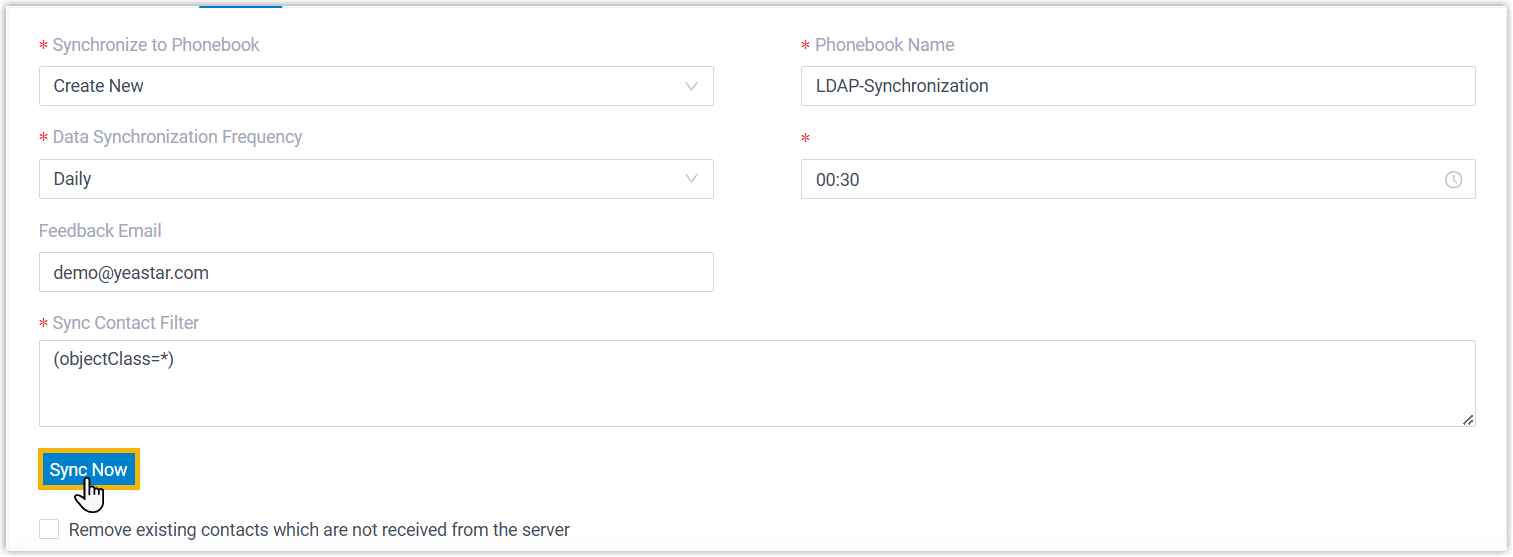
Click Sync Now to import the contacts immediately.
Result
Section titled “Result”-
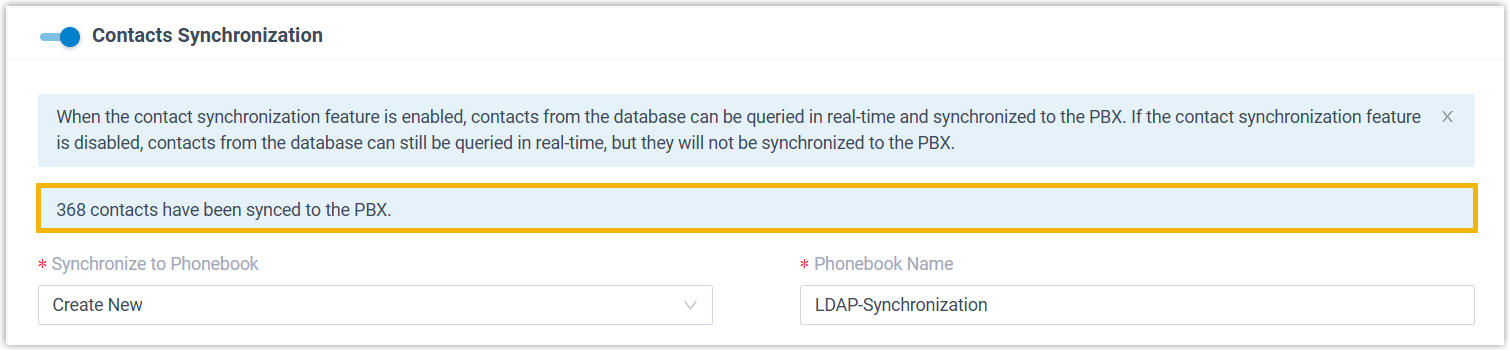
A banner confirms how many contacts were successfully synchronized.
-
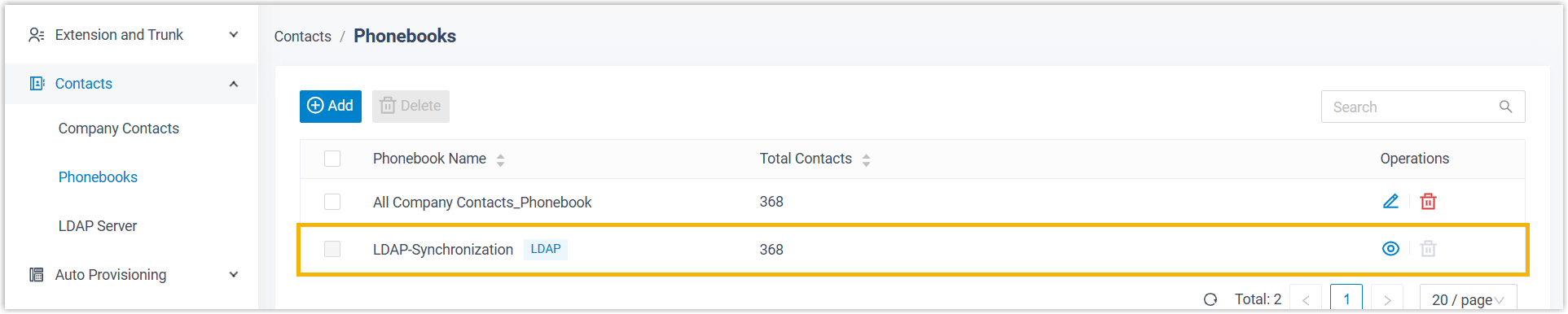
You can review the imported records and their phonebook(s) under Contacts > Company Contacts / Phonebooks. Synced items are marked with an LDAP tag
 .
.
-
Authorized extension users can view and call the contacts directly from the Cloud Voice App.
What to do next
Section titled “What to do next”To send inbound calls from LDAP contacts to specific destinations based on the phonebook they belong to, set up inbound routes that match callers against the contacts in each phonebook.
Question about this page?
Ask the AI assistant. It starts from this page, then searches the rest of the docs.
Ask Cloud Voice AI
Answers are AI-generated from the docs and may contain mistakes. Verify with the linked pages.