
Auto Provisioning Overview
Auto Provisioning lets you configure, deploy, and maintain IP (Internet Protocol) phones and gateways from a single place in Cloud Voice, instead of touching each device by hand. It removes most of the repetitive setup work, so rolling out and managing devices stays fast even at scale.
Devices you can auto provision
Section titled “Devices you can auto provision”Cloud Voice can auto provision both IP phones and Cloud Voice TA FXS (Foreign Exchange Station) gateways. An FXS gateway provides analog ports, so you can connect traditional analog phones or fax machines to the system.
- For IP phones, follow Auto Provision IP Phones Remotely with Proxy or Auto Provision IP Phones Remotely via RPS Method.
- For gateways, follow Auto Provision Cloud Voice TA FXS Gateway.
For the full list of models that Auto Provisioning supports, see Auto Provisioning - Supported Devices.
How Auto Provisioning works
Section titled “How Auto Provisioning works”Knowing how each provisioning method connects a phone to the PBX makes it easier to plan a deployment and to pinpoint where a problem lies when a device fails to provision. Cloud Voice offers two approaches: provisioning through an Onsite Proxy and provisioning through the RPS method.
Provision with Proxy
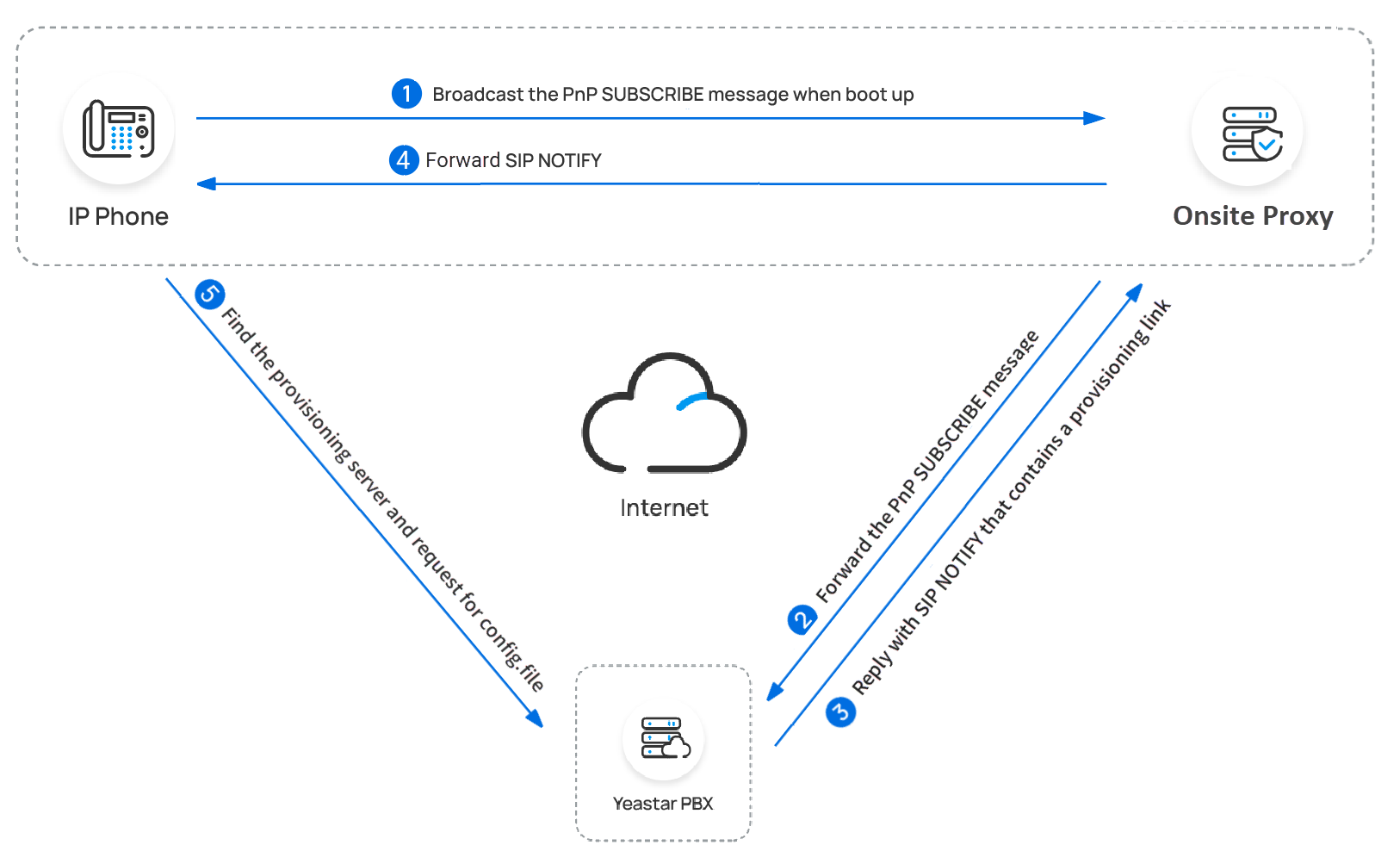
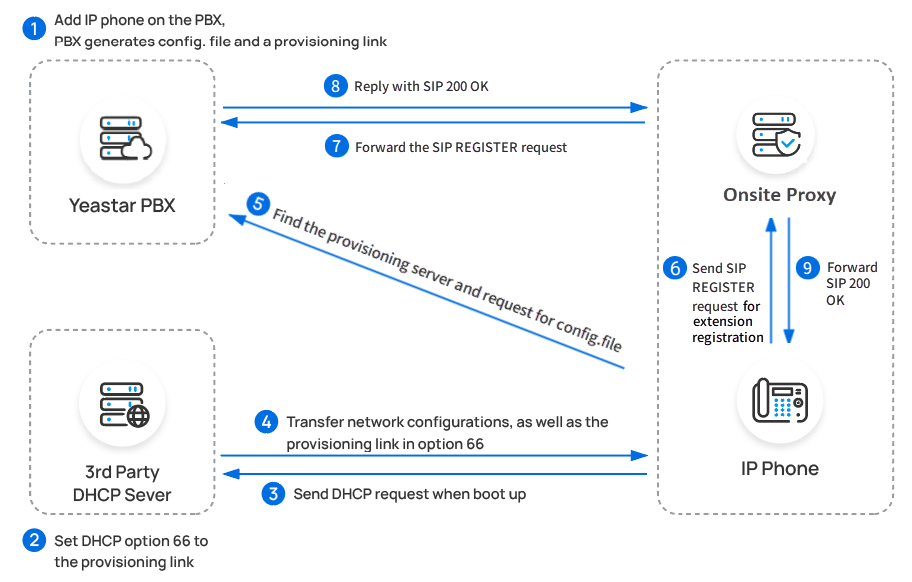
Section titled “Provision with Proxy”An Onsite Proxy is a service that sits on the customer’s local network. It registers phones to Cloud Voice through an encrypted tunnel, so the devices never need direct public access to the PBX. How a phone reaches the proxy depends on whether it supports PnP.
Phones that support PnP (Plug and Play, meaning the phone announces itself on the network and is set up automatically) are discovered and configured once they are on the same network as the proxy.
Phones that do not support PnP are provisioned with the help of a DHCP (Dynamic Host Configuration Protocol) server, which points them to the proxy. DHCP is the same service that hands out IP addresses on a network; here it also tells the phone where the proxy is.
Provision via RPS Method
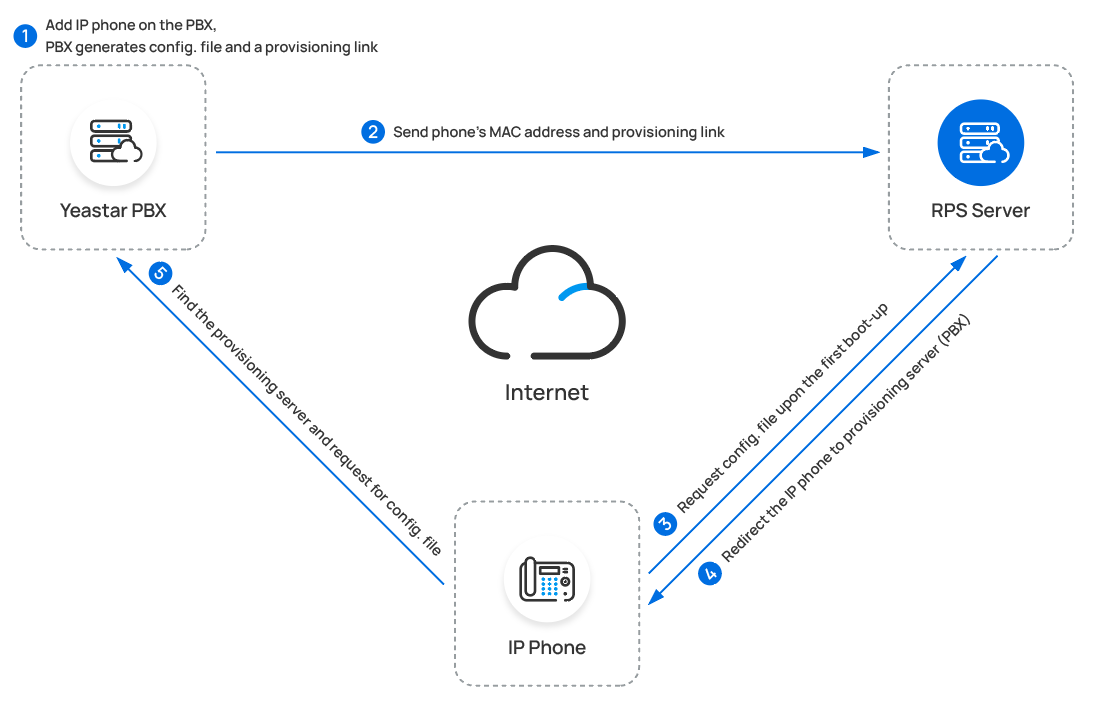
Section titled “Provision via RPS Method”With the RPS (Redirection and Provisioning Service) method, phones are redirected to the PBX for provisioning through a central redirection service, so no Onsite Proxy is required. This makes it well suited to deploying and updating large batches of devices with little manual effort.
Question about this page?
Ask the AI assistant. It starts from this page, then searches the rest of the docs.
Ask Cloud Voice AI
Answers are AI-generated from the docs and may contain mistakes. Verify with the linked pages.