
Control a Fanvil IP Phone from the Cloud Voice App Desktop
CTI (computer telephony integration) mode links a Fanvil desk phone to the desktop Cloud Voice App when both use the same extension. The audio still runs through the physical phone, but the app becomes an on-screen control surface for placing, answering, and managing those calls.
This applies to the Fanvil models that support CTI with the desktop Cloud Voice App. See the list of compatible Fanvil phones.
Before you begin
Section titled “Before you begin”Two conditions must be met before CTI mode will work:
- PBX server: The uaCSTA (user agent CSTA) connection must be turned on at PBX Settings > SIP Settings > Advanced > Other Options > Enable uaCSTA Connection. uaCSTA is the control channel that lets the app operate the desk phone over SIP (Session Initiation Protocol, the signaling used for VoIP calls). Your administrator controls this setting.
- Desk phone: The Fanvil phone must be registered with the same extension you use in the desktop Cloud Voice App.
Step 1. Make the desk phone controllable
Section titled “Step 1. Make the desk phone controllable”When the extension was registered manually, enable uaCSTA on the phone yourself. The steps below use a Fanvil X5S as an example; other models follow a similar flow.
- Sign in to the phone’s web interface and open Line > SIP.
- In the Line drop-down, choose your extension.
- Open the Advanced Settings section and type your extension number into the uaCSTA Number field.
- Open the SIP Global Settings section and select Enable uaCSTA.
- Click Apply.
Step 2. Switch the app into CTI mode
Section titled “Step 2. Switch the app into CTI mode”Putting the desktop Cloud Voice App into CTI mode lets you drive calls on the paired Fanvil phone from your computer.
-
Sign in to the desktop Cloud Voice App.
-
In the top-right corner, click the CTI icon
 , then pick your connected Fanvil phone from the list.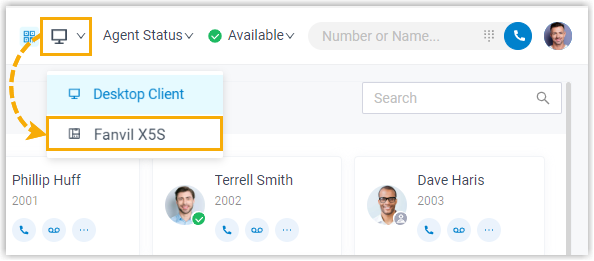
What you can do
Section titled “What you can do”Once CTI mode is active, you can handle the following from the app while the Fanvil phone carries the audio:
- Place and end a call
- Start a second call
- Answer or reject an incoming call
- Record a call
- Transfer a call, either attended or blind
- Hold and resume a call
- Swap between held calls
- Flip a call
Question about this page?
Ask the AI assistant. It starts from this page, then searches the rest of the docs.
Ask Cloud Voice AI
Answers are AI-generated from the docs and may contain mistakes. Verify with the linked pages.