
Initial Action
Initial Action is where every call flow begins. It defines which number or numbers callers dial to enter the flow, and it can play an opening prompt that greets callers or tells them what to do next.
Each call flow has exactly one Initial Action component. Cloud Voice adds it automatically when you create the flow, and you cannot remove it.
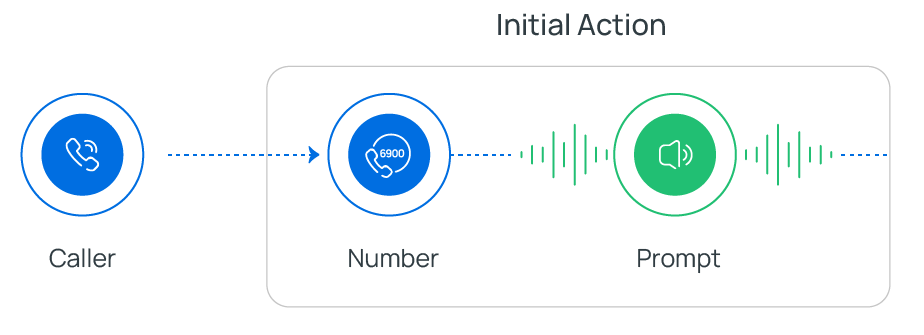
Numbers you can assign
Section titled “Numbers you can assign”Callers reach the flow by dialing a number tied to the Initial Action component. You can use an internal extension, one or more trunk DID numbers, or both. A DID (Direct Inward Dialing) number is a public phone number that routes an outside caller straight to a specific internal destination.
| Number type | Details |
|---|---|
| Extension number | Cloud Voice sets aside the range 6900 to 6999 for call flows. When you create a flow, it takes the first free number in that range, but you can also enter a custom number from outside it. |
| Trunk DID number(s) | Assign one or more of your trunk DID numbers so external callers can dial straight into the flow. |
Prompts you can play
Section titled “Prompts you can play”Adding an opening prompt is optional. When you want one, pick from the following types.
| Prompt type | Details |
|---|---|
| Custom Prompt | Pick an existing custom prompt, or make a new one by recording it from an extension or uploading an audio file. |
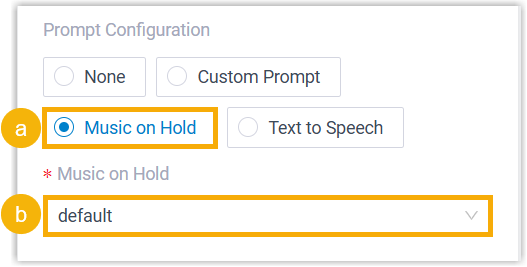
| Music on Hold (MoH) | Play one of your existing Music on Hold selections. |
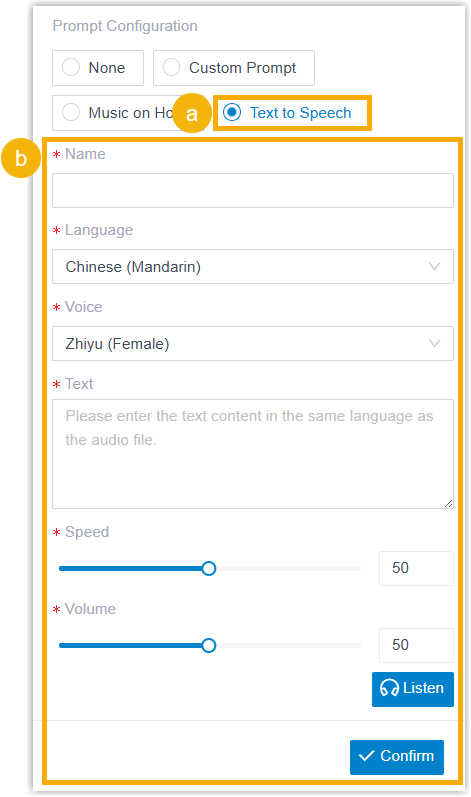
| Text to Speech (TTS) | Type the text you want callers to hear; Cloud Voice reads it aloud in the language and voice you choose. |
Configure the component
Section titled “Configure the component”-
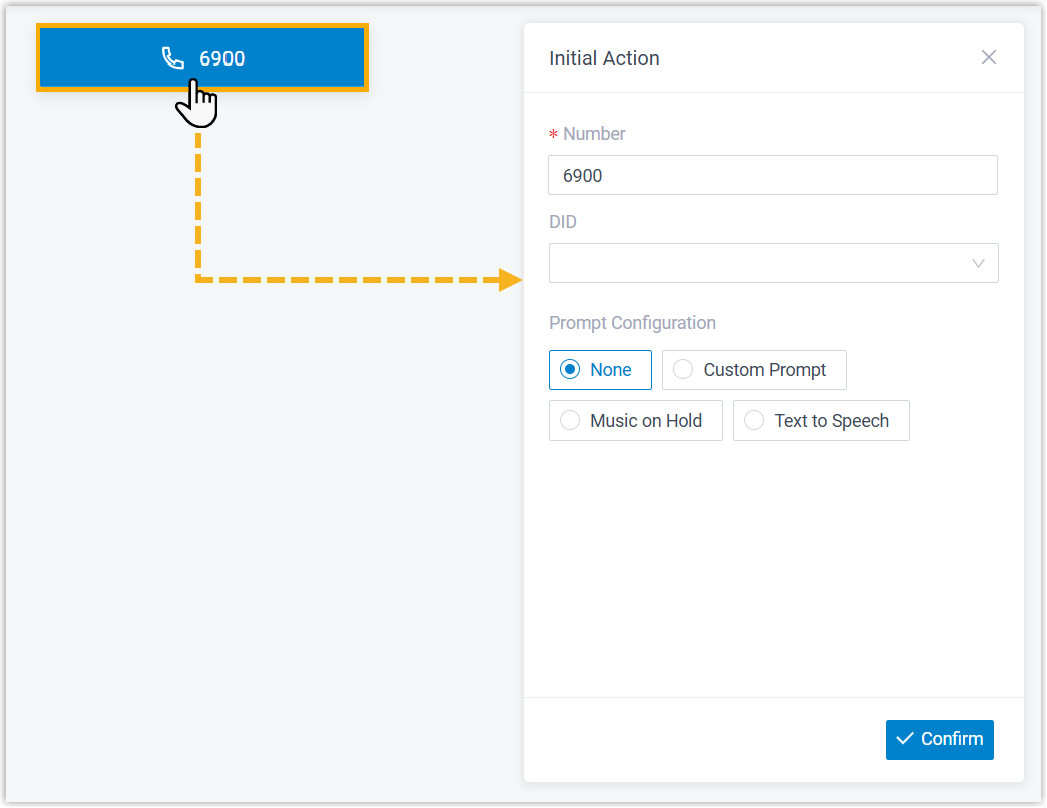
Once the call flow exists, click the Initial Action component to open its settings.
-
Set the number or numbers that callers dial to start the flow.
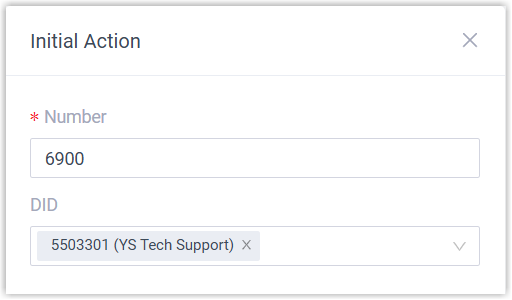
Field Details Number Keep the extension Cloud Voice assigned, or type your own. DID Optional. Choose one or more trunk DID numbers from the list. -
Optional: add an opening prompt or a text-to-speech message to greet callers or guide them. Configure whichever type you chose.
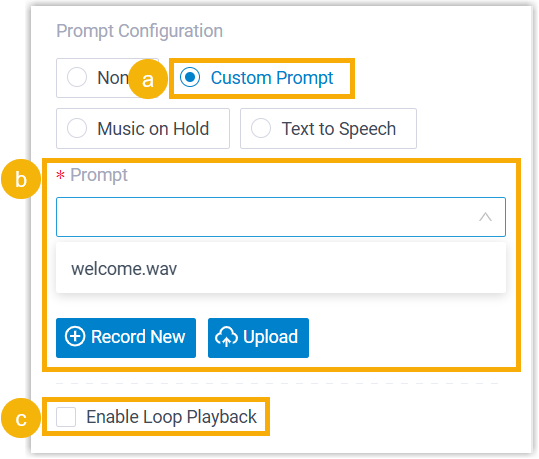
Custom Prompt
-
Select Custom Prompt.
-
Choose your prompt or prompts.
-
To reuse a saved prompt, pick it from the Prompt list.
-
To add a new one, click Record New to record from an extension, or Upload to add an audio file.
-
-
Optional: to repeat the prompt or prompts continuously, select Enable Loop Playback.
Music on Hold (MoH)
-
Select Music on Hold.
-
Pick an existing selection from the Music on Hold list.
Text to Speech (TTS)
-
Select Text to Speech.
-
Fill in the remaining settings. Cloud Voice converts your text to speech using those settings.
-
-
Click Confirm in the bottom-right corner. The number you chose then appears on the component.
Connect the next component
Section titled “Connect the next component”Initial Action connects to exactly one downstream component, which takes over once a caller enters the flow. You can connect any of the following.
| Component | What it does |
|---|---|
| Prompt | Plays an audio prompt or a text-to-speech message to the caller. |
| Business Hours | Routes calls to different destinations based on the time of day. |
| Menu | Presents a set of options and routes the call on the DTMF (Dual-Tone Multi-Frequency) keypad digit the caller presses. DTMF is the tone a phone makes when a key is pressed. |
| User Input | Collects DTMF digits, typically paired with Condition to route on what the caller entered. |
| Language | Changes the system-prompt language for the components that follow. |
| Record | Starts recording once the caller connects to another party, with optional notice prompts, or disables recording for a call that would otherwise be recorded. |
| Dial by Number | Lets callers dial a number directly to reach a destination. |
| Dial by Name | An end component that lets callers reach a user by entering the first three letters of their name. |
| Transfer | An end component that sends the caller to a set destination, optionally with a prompt announcing the transfer. |
| Hang Up Call | An end component that disconnects the caller. |
| Condition | Routes calls based on logical expressions. |
| Loop | Repeats a group of components a set number of times or until a condition is met. |
| Internal Data Ops | Reads and updates data in the PBX’s built-in database. See Get Extension Presence Status, Set Extension Presence Status, Get Queue Agent, Get Queue Info, Get Agent Status, Set Agent Status, Get System Info, Get System Capacity, Get Extension Info, and Get Company Contact Info. |
| Email Sender | Sends email for real-time notifications, alerts, or user-specific information. |
| Database Access | Runs SQL against a database mid-call to read or update data. |
| HTTP Request | Sends HTTP requests to external servers to exchange data with third-party services. |
Question about this page?
Ask the AI assistant. It starts from this page, then searches the rest of the docs.
Ask Cloud Voice AI
Answers are AI-generated from the docs and may contain mistakes. Verify with the linked pages.